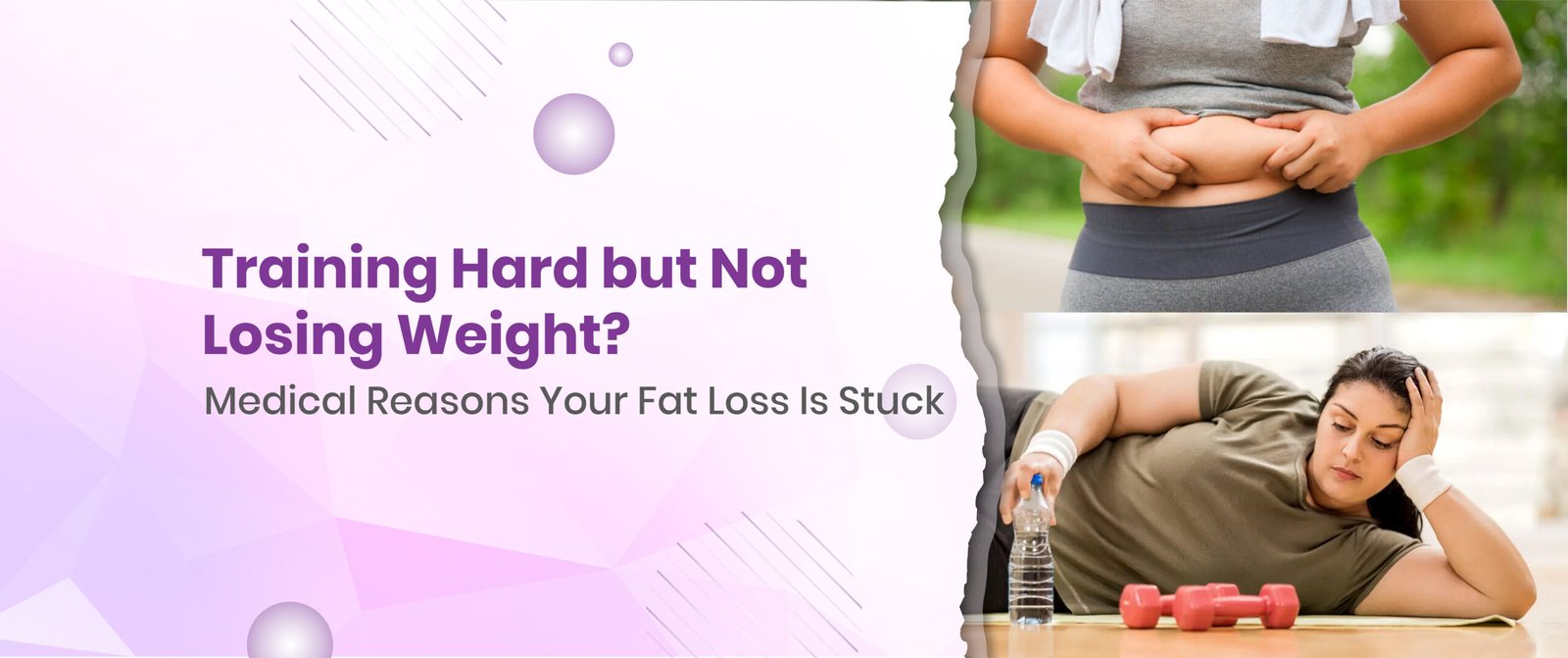
Training Hard but Not Losing Weight? Why Fat Loss Often Gets Stuck
Many people come in with the same concern: “I’m regularly exercising, eating less than before, and still not losing weight.”
They’re tired, frustrated, and often blaming themselves. Some feel they lack discipline. Others think they need to train even harder or eat even less.
In most cases, the problem is not effort. It’s how the body responds to prolonged stress.
Fat loss is not just about burning calories. It is controlled by the body’s internal systems — metabolism, hormones, recovery, and inflammation. When these systems are strained, fat loss slows or stops, even when effort increases.
When Effort Increases but Results Don’t
In the beginning, most weight-loss plans work. Calories reduce, activity increases, and the body responds.
But after a few weeks or months, progress slows. Weight plateaus appear. Clothes stop fitting differently. Energy drops.
At this point, many people assume they are doing something wrong. In reality, the body is doing what it is designed to do — protect itself.
Why Fat Loss Works at First — Then Slows Down
The body is excellent at adapting.
When calorie intake drops:
Energy use decreases
Hunger signals increase
Fat loss becomes less efficient
This is a survival response. The body does not know you are trying to lose weight. It only senses that energy availability is lower than before.
Over time, the same diet and exercise routine produces fewer results. This is not failure — it is adaptation.
How the Body Adjusts When Calories Stay Low for Too Long
When calorie restriction continues for long periods, the body begins to conserve energy.
This can include:
Slower resting metabolism
Reduced spontaneous movement during the day
Increased fatigue
Stronger hunger signals
People often say, I’m eating very little, but nothing is changing. At this stage, eating less often worsens the problem.
Fat loss requires the body to feel safe enough to release stored energy. Constant restriction sends the opposite message.
Why More Exercise Doesn’t Always Mean More Fat Loss
When weight loss stalls, the most common response is to add more exercise.
More workouts. More cardio. Longer sessions.
While exercise is important for health, too much training with too little recovery can backfire.
Excessive training increases stress hormones, especially when food intake is low. Over time, this can:
Slow fat loss
Increase muscle breakdown
Increase fatigue
Worsen sleep quality
The body shifts from burning fat to conserving energy.
When Hormones Start Working Against Fat Loss
Fat loss is guided by hormones, not willpower.
Several hormones play a role:
Insulin (energy storage)
Leptin (signals fullness and energy availability)
Cortisol (stress hormone)
Thyroid hormones (control metabolic rate)
With prolonged dieting, intense training, poor sleep, or high stress, these signals can become disrupted.
This may lead to:
Increased fat storage
Reduced metabolic rate
Difficulty losing fat despite effort
At this point, pushing harder usually makes progress slower.
How Ongoing Stress and Inflammation Block Progress
Low-grade inflammation is a common but overlooked reason fat loss gets stuck.
Inflammation can come from:
Poor sleep
Over training
Nutrient deficiencies
Gut issues
Unresolved injuries
High mental stress
When inflammation is present, the body focuses on repair and protection — not fat loss.
People often say: “I feel tired all the time.” “I’m sore even with light workouts.” “I’m doing everything right, but nothing is changing.”
These are signs the body is under strain.
Why Eating Less Doesn’t Always Lead to More Weight Loss
There is a limit to how much calorie reduction helps.
Beyond a certain point:
Metabolism slows further
Hormonal signals worsen
Muscle loss increases
Fat loss resistance increases
This is why some people eat very little but still don’t lose fat.
The problem is not food quantity alone — it’s the body’s response to prolonged restriction.
The Role of Muscle Loss and Poor Recovery
Muscle tissue helps keep metabolism active.
When calorie intake is low and recovery is poor:
Muscle loss occurs
Resting metabolism drops
Fat loss becomes harder
Many people lose weight initially, but much of it comes from muscle rather than fat. This makes long-term fat loss more difficult.
Recovery — sleep, rest days, proper nutrition — is not optional. It is essential for sustainable fat loss.
Why the Weighing Scale Can Be Misleading
Body weight does not always reflect fat loss or health.
Weight can stay the same while:
Body fat increases
Muscle mass decreases
Inflammation increases
Relying only on the scale can hide underlying problems. Fat loss stalls are often a sign of deeper metabolic stress, not lack of effort.
What Often Gets Missed Before Trying Another Diet or Workout
Most people try multiple diets and exercise plans without understanding their body’s current state.
What often gets missed:
Metabolic health
Hormonal balance
Recovery adequacy
Training load tolerance
Inflammation levels
Without addressing these factors, fat loss becomes a cycle of effort and frustration.
Why Improving Health Comes Before Losing Fat
Sustainable fat loss is not forced — it follows improved health.
When the body is:
Well-rested
Properly fuelled
Less inflamed
Trained appropriately
fat loss resumes naturally.
Trying to lose fat without restoring balance often leads to repeated plateaus.
A Smarter, Medical Approach to Stuck Fat Loss
At Ziathlon, stalled fat loss is approached medically — not as a discipline issue.
The focus is on:
Understanding metabolic and hormonal status
Aligning training with recovery
Supporting the body instead of stressing it further
Addressing inflammation and fatigue
When the system improves, fat loss follows.
The One Thing Most People Don’t Realise About Fat Loss
Fat loss is not about pushing harder forever.
It is about knowing when to push and when to restore.
If you are training hard but not losing weight, your body is not failing you — it is protecting you.
The solution is not more punishment. It is smarter care.
Fat loss works best when the body feels supported, not threatened.