
Why Do Sports Injuries Happen Even When There Is No Pain?

One of the most common things athletes say after an injury is:
“I didn’t feel any pain before it happened.”
To most people, pain is assumed to be the body’s warning signal. If something is wrong, it should hurt. If it doesn’t, everything must be fine.
In sport and fitness, this belief is one of the most misleading—and costly—assumptions.
Many sports injuries do not begin with pain, swelling, or obvious discomfort. They develop silently, over weeks or months, while the athlete continues to train, compete, and often improve performance. When pain finally appears, the injury is no longer new—it is already established.
Understanding why this happens requires looking beyond symptoms and into how the body adapts, compensates, and eventually fails.
In clinical sports medicine, injuries are rarely sudden events. Even injuries that appear “acute” often have a long, invisible build-up phase.
During this phase:
- Training load continues to increase
- Movement quality subtly deteriorates
- Recovery becomes insufficient
- Tissues begin to lose capacity
The body adapts for as long as it can. Injury occurs when adaptation is no longer possible—not when pain first appears.
Pain is not the start of injury.
It is often the final signal that the system has reached its limit.
Silent Tissue Overload: Damage Without Pain
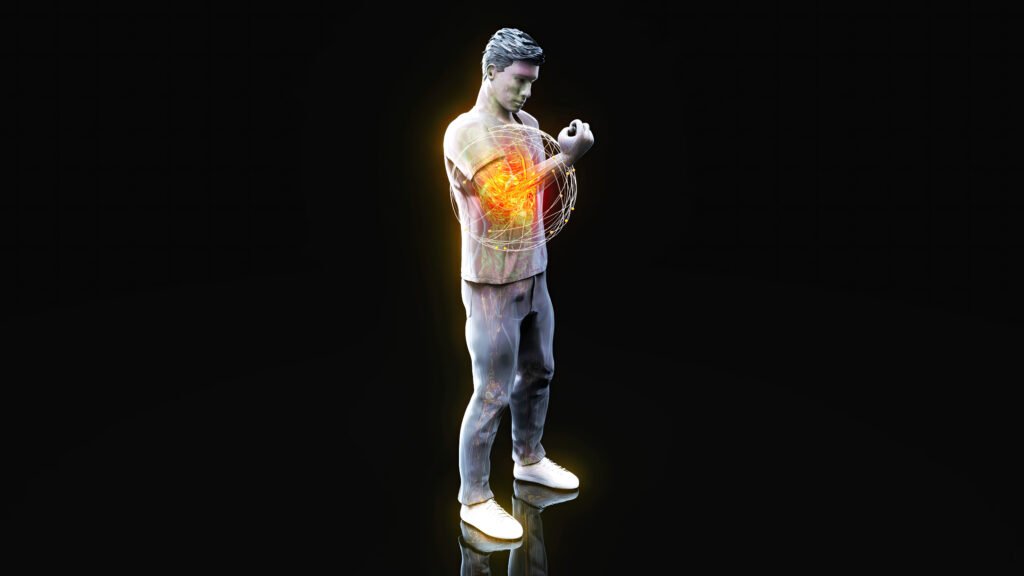
Every tissue in the body—muscle, tendon, ligament, cartilage, bone—has a specific tolerance to load.
When training stress stays within that tolerance, tissues adapt and strengthen. When load repeatedly exceeds recovery capacity, microscopic damage accumulates.
In the early stages, this damage is often:
- Non-inflammatory
- Structurally subtle
- Painless
Tendons are a classic example. Early tendon overload can progress for months with:
- Normal strength
- No pain during training
- Mild stiffness that disappears after warm-up
Clinically, this is one of the most dangerous stages. The athlete feels capable and confident, while tissue quality is quietly declining.
By the time pain appears, the tendon has already lost resilience.
Why Strong Athletes Still Get Injured
A common mistake is that injuries happen because athletes are weak.
In reality, many injured athletes are strong, fit, and performing well. Their issue is not strength—it is how load is managed and distributed.
As training progresses:
- Performance can improve faster than tissue capacity
- Strength can increase while recovery lags
- Confidence can rise while movement efficiency declines
This creates a dangerous gap where athletes feel better, move harder, and train more—while injury risk quietly increases.
Performance and resilience are not the same thing.
Neuromuscular Delay: When Timing Fails Before Strength
One of the most overlooked contributors to pain-free injury is neuromuscular control—the timing and coordination between the brain and muscles.
Efficient movement depends on muscles activating at the right time, not just being strong.
When neuromuscular timing is compromised:
- Stabilizing muscles activate milliseconds too late
- Joints lose dynamic protection
- Passive structures absorb excessive force
This delay is painless. Athletes do not feel it happening.
In clinical assessments, it is common to see athletes who test strong in the gym but demonstrate poor control during:
- Landing
- Deceleration
- Direction changes
- Fatigued movement
Over thousands of repetitions, these small timing errors place excessive stress on joints, tendons, and ligaments.
Movement Inefficiencies: Compensation Without Awareness
The human body is remarkably good at compensating.
If one joint loses mobility, another moves more.
If one muscle fatigues, another works harder.
This allows athletes to continue training and competing—but at a cost.
Common silent compensations include:
- Reduced hip contribution with increased knee or lower back stress
- Limited ankle mobility altering landing mechanics
- Asymmetrical loading patterns during squats or running
- Excessive spinal movement replacing hip control
These compensations are rarely painful at first. They become habitual. Over time, load concentrates in tissues that are not designed to handle it.
Injury does not occur because movement stops—but because inefficient movement continues.
Fatigue: The Invisible Risk Multiplier
Fatigue is one of the strongest predictors of injury, yet it often goes unnoticed.
As fatigue accumulates:
- Reaction time slows
- Muscle coordination deteriorates
- Joint stability decreases
- Technique becomes less controlled
These changes are subtle and painless. Athletes often feel “normal,” especially during warm-ups.
Injuries associated with fatigue rarely result from a single bad movement. They result from repeated compromised movements performed when control has already declined.
Why Pain Appears Late
Pain is not a direct measure of tissue damage. It is a protective output of the nervous system.
The brain delays pain when:
- Function can still be maintained
- Compensation is effective
- The perceived threat is manageable
Highly trained athletes often have:
- Higher pain thresholds
- Strong motivation to perform
- Nervous systems conditioned to tolerate stress
This is why many athletes say:
“I felt great… and then suddenly it happened.”
The body did not fail to warn them.
The warning signs appeared earlier—just not as pain.
Why Scans Can Be Normal Before Injury
Another common misunderstanding is relying on imaging as a predictor of injury.
Early-stage overload often:
- Does not appear on scans
- Shows minimal structural change
- It Is functional rather than anatomical
Risk is determined by how tissues are loaded, how movement is controlled, and how recovery is managed—not just by what imaging shows.
This is why athletes can have “normal” scans and still be at high risk of injury.
The Missed Opportunity: Waiting for Symptoms

Most athletes seek professional help only when pain interferes with training.
By then:
- Tissue capacity has already declined
- Recovery timelines are longer
- Performance setbacks are unavoidable.
Pain-based care is reactive.
Risk-based care is preventive.
Early identification through medical screening, movement assessment, and load evaluation allows intervention before breakdown occurs.
What Athletes Should Pay Attention To
Pain is not the only signal that matters.
Early warning signs include:
- Stiffness that takes longer to resolve each week
- Recurrent tightness always on the same side
- Declining coordination under fatigue
- Performance plateaus despite increased training
- Minor niggles that keep returning or shift locations
These signs often appear weeks or months before injury.
Rethinking Injury Prevention

Preventing pain-free injuries requires a shift in mindset.
Instead of asking:
Does it hurt?
We must ask:
Is the body coping with current demands?
Answering that question requires an integrated approach—where medical insight, movement quality, training load, nutrition, and recovery are evaluated together, not in isolation.
This is where modern sports medicine and performance systems intersect.
Sports injuries rarely happen without warning.
They happen when early warning signs go unnoticed.
Pain is a late message.
Injury is a long process.
Athletes who stay healthy the longest are not the ones who wait for pain—but the ones whose systems are assessed, monitored, and supported before breakdown occurs.
In sport, protecting performance starts long before pain begins.